08 // Consulting Case Study
ADVERSARY CAPABILITY ASSESSMENT FROM RECOVERED PROCUREMENT RECORDS

MAXWELL CONTINUUM — CONSULTING DIVISION
TECHNICAL EXPLOITATION REPORT MC-2026-001
CLASSIFICATION: UNCONTROLLED — RELEASED FOR PUBLICATION
In early 2026, the consulting division received a recovered procurement manifest listing three items acquired by an unidentified adversary through coordinated theft from separate research facilities. No accompanying documentation was provided. No context regarding the adversary's identity, resources, or operational history accompanied the manifest. The request to Maxwell Continuum was narrow: infer the adversary's intended system architecture and operational capability from the procurement list alone.
The methodology is standard intelligence-community practice. A procurement manifest is a capability declaration read backwards. Every item on a parts list implies a function. Every function implies a subsystem. The subsystems, taken together, imply an integrated architecture — and the architecture implies intent. The adversary does not need to describe what they are building. The shopping list describes it for them.
Three items were recovered. Each is assessed individually below, followed by an integrated capability analysis.
Item 1 — Adversary Designation: “Positronic Accelerator”
ASSESSED ROLE: ENERGY INJECTION
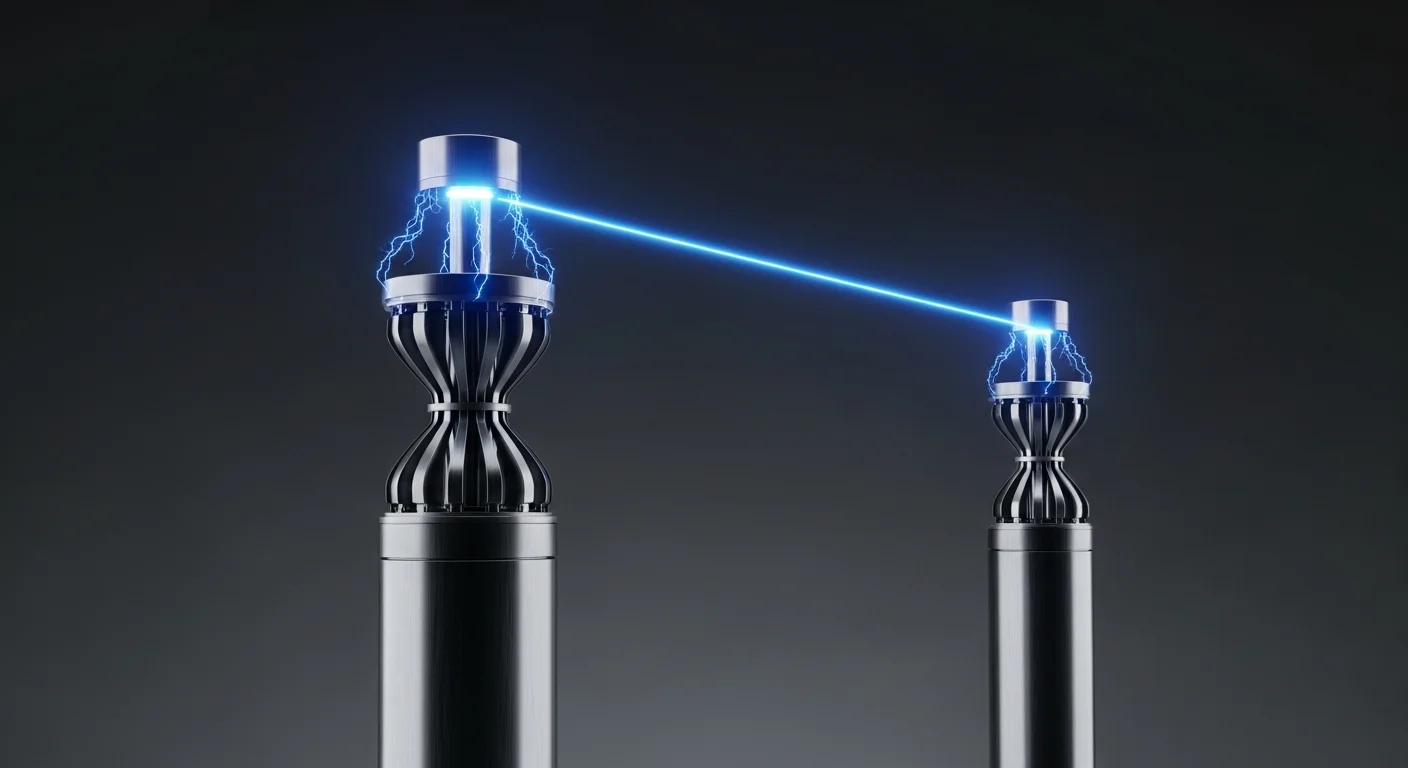
The field nomenclature suggests a compact charged-particle acceleration system with pair-production capability. The qualifier “positronic” is significant: it indicates the system is designed to generate positrons (the antimatter counterpart of the electron), which requires a target assembly — most likely high-Z material such as tungsten or depleted uranium — intercepting a primary electron beam at sufficient energy to exceed the 1.022 MeV pair-production threshold. The accelerator itself is assessed as a compact linear induction accelerator (LIA) in the 10–50 MeV class, capable of producing pulsed relativistic electron beams with peak currents in the kiloampere range.
This is the energy injection layer of the system. It generates the charged-particle population upon which all downstream functions depend. No sensing, no control, no signal shaping — raw energy in the form of a directed particle beam. The choice of a pair-production-capable accelerator rather than a simpler electron-only system suggests the adversary either intends to exploit positron-specific interactions (annihilation gamma production, antimatter-catalysed energy release) or has overspecified the hardware for a simpler beam-weapon application. Both interpretations indicate access to competent physics guidance.
Maxwell Continuum equivalent: Roentgen Hammer electron source stage (compact LIA / LWFA front end). See Section 02, Band 4.
Item 2 — Adversary Designation: “Reverse Flux Polarity Indicator”
ASSESSED ROLE: FIELD DIAGNOSTICS AND CONTROL
The nomenclature describes a real-time magnetic field diagnostic system with specific sensitivity to field-direction reversals and phase inversions. The operational term “reverse flux polarity” maps directly to detection of sign changes in the magnetic vector field — a measurement that is critical in any system using magnetic optics to steer, focus, or confine charged-particle beams. A polarity error in a beam-steering quadrupole magnet converts a focusing element into a defocusing element. In a confinement geometry, a polarity reversal collapses the magnetic mirror. The adversary's decision to acquire dedicated polarity-monitoring hardware indicates awareness of this failure mode.
The hardware is assessed as an integrated diagnostic array: Hall-effect sensor matrices for DC and slowly varying fields, fluxgate magnetometers for high-sensitivity absolute measurement, and phase-resolved signal analysers for detecting dynamic field oscillations and sign transitions. The combination provides continuous monitoring of magnetic field topology across a beam transport line or confinement region.
This is the control and sensing layer. Without it, beam transport magnets cannot be verified, steering optics cannot be calibrated, and any dynamic magnetic geometry will drift into instability undetected. The fact that the adversary procured this component separately from the accelerator — rather than relying on whatever diagnostics ship with the accelerator — indicates an intent to build a system more complex than a simple beamline. The adversary expects to encounter field conditions that require independent, dedicated monitoring.
Maxwell Continuum equivalent: H-Array beam diagnostic subsystem; Analog Field Solver magnetic-topology monitor. See Section 02 and Section 03.
Item 3 — Adversary Designation: “Parabolic Sine Wave Generator”
ASSESSED ROLE: WAVEFORM SHAPING AND SYSTEM ORCHESTRATION
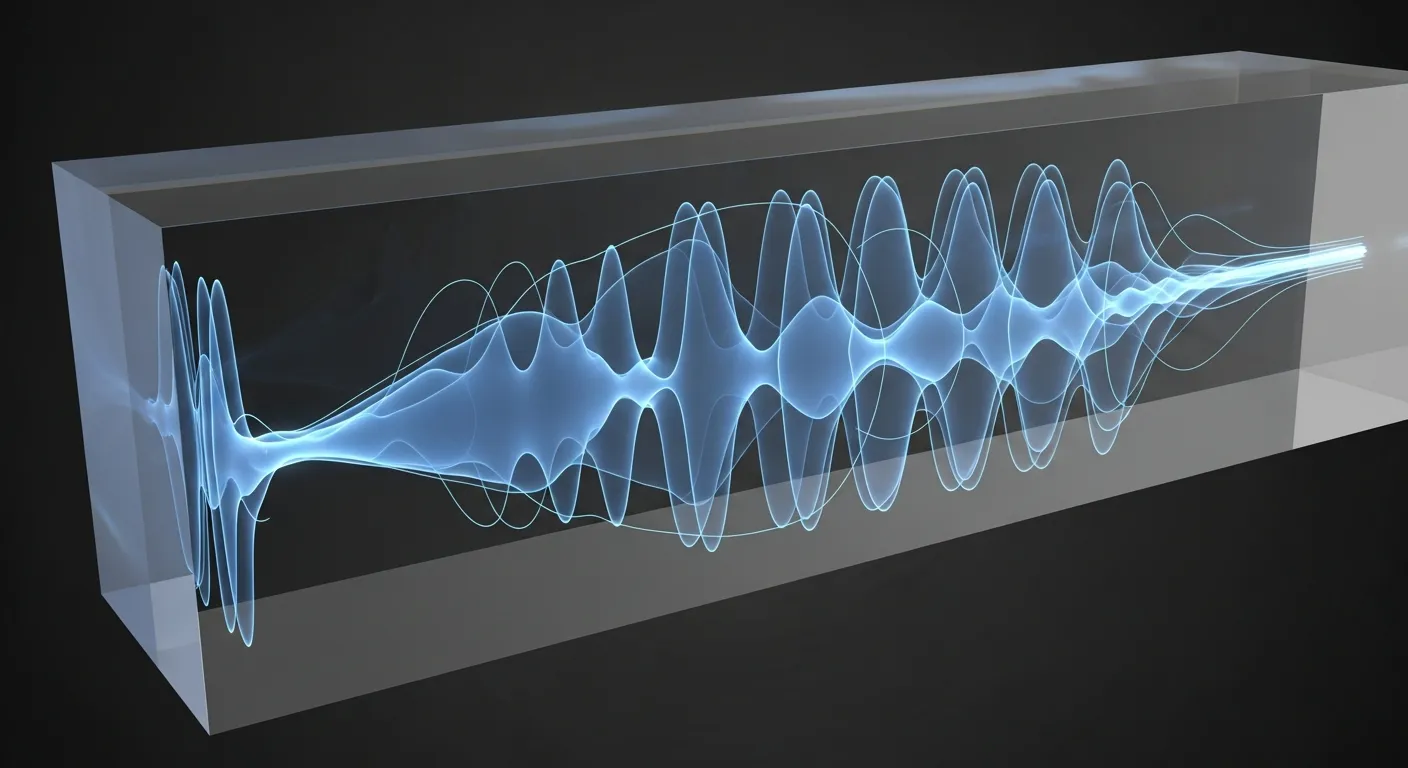
The compound nomenclature, though superficially unusual, encodes two distinct and meaningful signal characteristics: a sinusoidal carrier and a parabolic amplitude envelope. This describes a specific class of shaped waveform in which a periodic drive signal is amplitude-modulated by a quadratic envelope function. The resulting pulse shape is not arbitrary — it is optimised. A parabolic envelope ramps power delivery smoothly from zero to peak and back, avoiding the instantaneous power transients of rectangular pulses (which shock the source hardware and degrade component lifetime) while delivering higher integrated energy per pulse than Gaussian profiles (which waste the tails). The parabolic sine pulse is, in fact, a near-optimal thermal management waveform for pulsed-power systems operating at high repetition rates.
The hardware is assessed as an arbitrary waveform generator (AWG) with nonlinear envelope-shaping capability, driving the RF cavities or magnetic pulse-forming networks that control beam acceleration timing and pulse structure. This is not a simple oscillator. It is a precision temporal controller.
This is the driver and orchestration layer. It determines the temporal behaviour of the entire system: pulse repetition rate, energy per pulse, burst structure, inter-pulse cooling intervals, and thermal duty cycle. It is the component that transforms a laboratory beam source into an operational weapon system — one that can fire repeatedly without destroying itself.
Maxwell Continuum equivalent: Meridian pulse-shaping electronics; H-Array beamformer waveform controller. See Section 02 and Section 03.
Integrated Capability Assessment
The three recovered items form a minimal but complete directed-energy weapon architecture. They map to the three irreducible layers required by any system that generates, controls, and delivers high-energy electromagnetic or particle-beam effects:
| LAYER | ADVERSARY DESIGNATION | ASSESSED HARDWARE | FUNCTION |
|---|---|---|---|
| Energy | Positronic Accelerator | Compact linear induction accelerator | Generate and accelerate charged-particle beam |
| Control | Reverse Flux Polarity Indicator | Hall-effect / fluxgate diagnostic array | Monitor and stabilise magnetic beam optics |
| Driver | Parabolic Sine Wave Generator | Arbitrary waveform generator with envelope shaping | Shape pulse structure for sustained operation |
The adversary is not building an explosive device. Explosives require neither field diagnostics nor waveform shaping. The adversary is building a system that must be operated — aimed, stabilised, pulsed, and sustained across multiple firing cycles. The procurement of sensing and control hardware alongside the energy source is the decisive indicator: the intent is a reusable directed-energy platform, not a single-use munition.
The system's minimum viable configuration — compact LIA, magnetic quadrupole steering with Hall-effect feedback, AWG-driven pulse-forming network — is achievable with components available from commercial accelerator and RF instrumentation suppliers. The primary engineering challenge is beam transport: maintaining focus and pointing accuracy over operationally useful distances requires the magnetic diagnostic loop (Item 2) to close with sub-millisecond update rates. The recovered hardware meets this requirement.
Conclusion
The recovered procurement manifest describes a coherent, buildable directed-energy system. The adversary's component selection demonstrates systems-level competence — the three items correspond precisely to the three functional layers (energy injection, field control, waveform shaping) that recur in every high-energy field system, from particle accelerators to fusion experiments to directed-energy weapons. This is not coincidence and not opportunistic acquisition. It is evidence of engineering understanding.
It is worth noting that this three-layer architecture — source, sensor, driver — is not specific to directed energy. It is the irreducible minimum for any system that manipulates high-energy fields. The same decomposition governs plasma confinement, resonance control, and RF cavity design. The procurement list reveals not only what the adversary intends to build, but how they think about field systems in general. That understanding, more than any single piece of hardware, is the capability that warrants continued monitoring.
Assessment prepared by Maxwell Continuum Consulting Division. Technical queries may be directed to the parent organisation, Maxwell Continuum.