02 // Product Line
FIVE SOURCE FAMILIES AND ONE OPTICAL BACKBONE
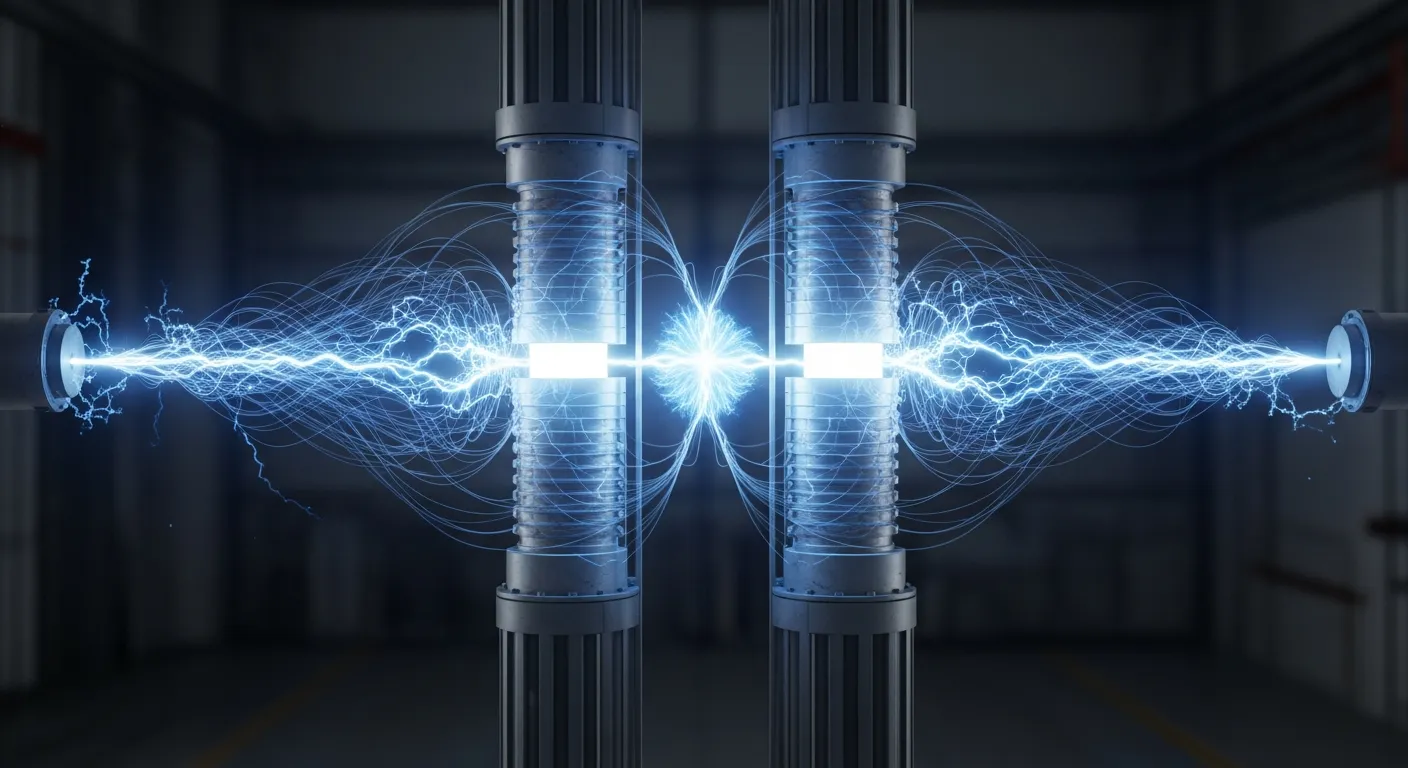
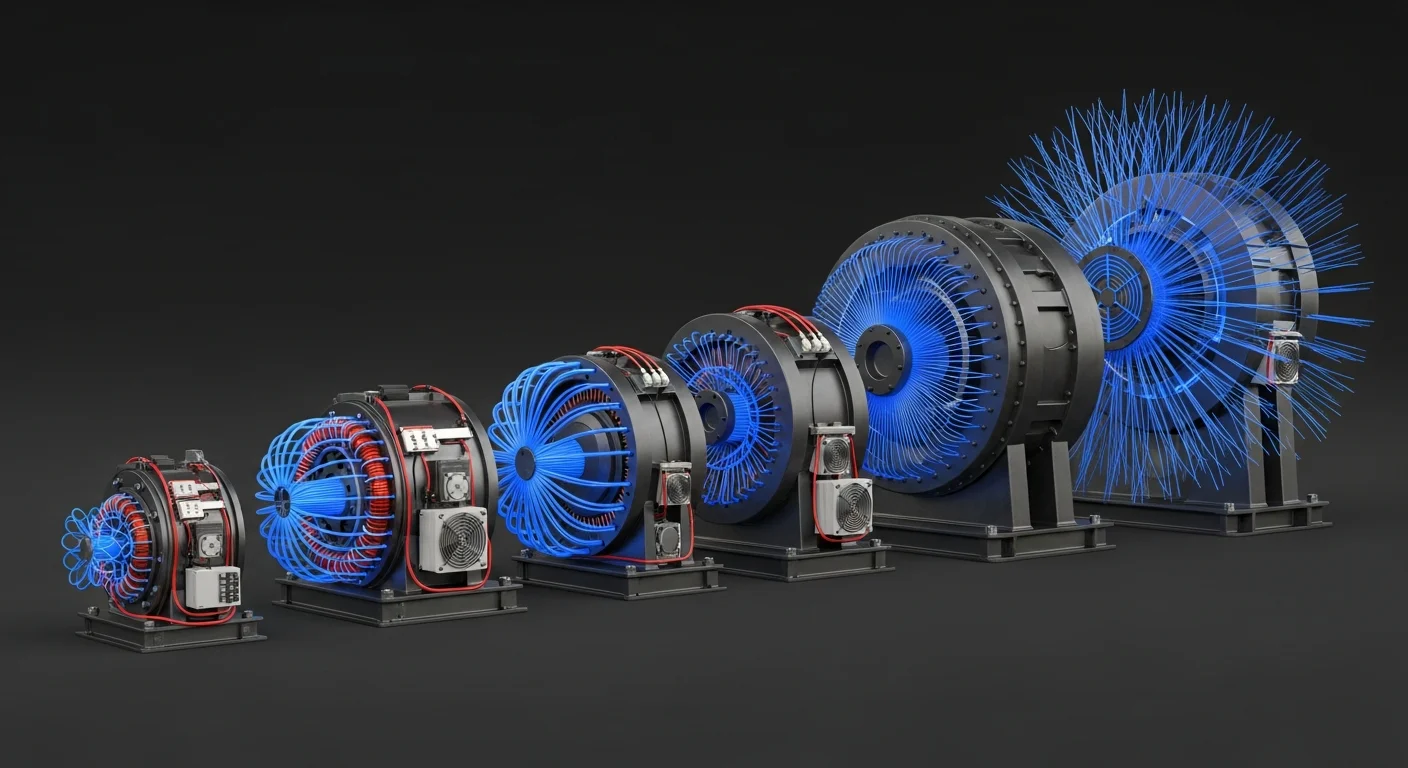
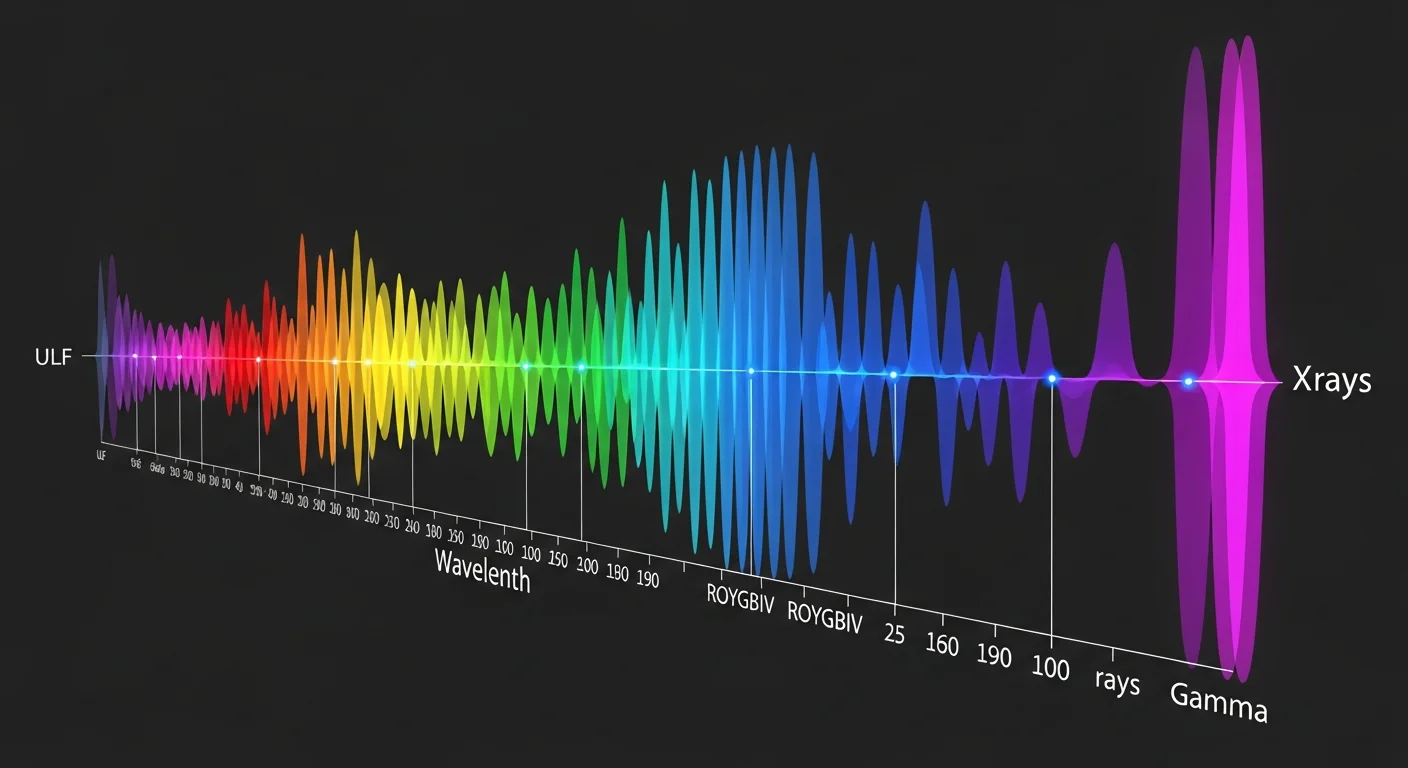
Five source families and one cross-cutting communications backbone. Each family is optimised for its frequency domain, built from the source physics that domain demands, and integrated into the broader Maxwell Continuum ecosystem through specific interface contracts.
Ultra-low-frequency magnetic field modulation using superconducting coils as antennas. At these frequencies, the wavelength exceeds the diameter of the Earth — there is no meaningful radiation; the system operates in the near-field regime, creating quasi-static magnetic field patterns that penetrate rock, seawater, and conductive shielding that would block every other band in the portfolio.[3]
The source physics is magnetostatic: current through a superconducting loop generates a dipole field whose strength falls as 1/r³. No power amplifier, no antenna gain, no beam steering in the conventional sense. Instead, spatial control comes from array geometry — multiple coils driven with calculated phase offsets create interference patterns in the magnetic field that can be slowly swept through a volume. One cycle of a 10−4 Hz signal takes nearly three hours to complete.
Applications: Subsurface geological survey and mineral detection. Through-earth communication with subterranean Modular Habitats Geo-Core installations. Structural resonance monitoring of large infrastructure. Environmental conditioning research.
A modular phased-array panel that beam-steers microwave energy without mechanical parts. Each panel tile contains gallium nitride high-electron-mobility transistors (GaN HEMTs) grown on silicon carbide substrates — a wide-bandgap semiconductor combination that delivers high power density, high breakdown voltage, and efficient thermal extraction simultaneously.[4] The choice of GaN over legacy GaAs or silicon LDMOS reflects the fundamental materials advantage: GaN's breakdown field is approximately ten times that of silicon, enabling power densities above 40 W/mm at X-band frequencies.
Beam steering is electronic. Each element in the array receives an independent phase command from a central beamformer. The resulting wavefront, shaped by constructive and destructive interference across the aperture, can be redirected in microseconds — no mechanical gimbal, no inertia, no wear. The beam can split: multiple simultaneous beams track different targets or serve different functions from the same aperture. This is the principle behind every modern military AESA radar, applied here to wireless power transfer and industrial sensing.[5]
Wireless Power Transfer: Directed microwave power delivery to fixed receivers and Lorentz Aerospace craft. The efficiency of far-field wireless power transfer scales with aperture area, frequency, and receiver size. At 5.8 GHz — the ISM-band sweet spot for atmospheric propagation — an H-Array panel delivers kilowatt-class power to a matched rectenna at ranges measured in hundreds of metres. Array tiling extends this to multi-kilowatt delivery over kilometre distances.
Radar & Sensing: High-resolution synthetic-aperture imaging. Material characterisation via microwave spectroscopy. Perimeter surveillance with electronic beam scanning.
Directed Energy: At higher power settings, the same aperture that transfers power or senses a scene can deliver concentrated microwave energy for electronics disruption and active denial in controlled environments.
Terahertz radiation occupies the gap between electronics and optics — frequencies too high for transistor oscillators, too low for conventional laser transitions. This "THz gap" has historically limited source power and detector sensitivity. The Deep-Look system bridges it using two complementary source technologies.[6]
The primary source is a quantum cascade laser — a semiconductor heterostructure in which electrons cascade through a series of coupled quantum wells, emitting a photon at each step. Unlike conventional lasers where photon energy is set by the bandgap, QCL emission wavelength is determined by quantum well thickness, which is an engineering parameter. This means the same III-V material system (typically GaAs/AlGaAs) can be designed to emit anywhere from the mid-infrared through the terahertz, simply by adjusting layer dimensions during epitaxial growth.[7]
The secondary source is a photoconductive antenna array driven by femtosecond pulses from the Meridian laser platform. An ultrashort optical pulse strikes a biased semiconductor gap (typically low-temperature-grown GaAs), generating a transient photocurrent whose spectral content spans the THz band. This pulsed mode enables time-domain spectroscopy — the system measures both amplitude and phase of the transmitted THz pulse, extracting material refractive index and absorption coefficient simultaneously.
T-rays pass through plastic, ceramic, dry wood, cloth, and most building materials, but reflect strongly from metal, water, and skin. This penetration profile makes THz imaging ideal for non-destructive evaluation of composite structures, detection of hidden defects in ceramic and polymer components, and continuous structural health monitoring.
Applications: Embedded in the walls of Modular Habitats for continuous non-invasive structural health monitoring. Quality verification of Metallic Sciences ceramic and composite components. Security screening. Pharmaceutical tablet inspection. Paint and coating thickness measurement.
The Meridian is a tunable laser platform with swappable gain modules covering the visible through near-ultraviolet spectrum. The architecture separates the resonator infrastructure — cavity optics, thermal management, beam delivery, diagnostics, and control electronics — from the gain medium itself. Changing the application means changing a module, not building a new laser.[8]
Module A — Ti:Sapphire (Ti:Al₂O₃): The broadband ultrafast workhorse. Titanium-doped sapphire has the widest gain bandwidth of any solid-state laser medium (650–1100 nm), supporting Kerr-lens mode-locked pulses as short as 5 femtoseconds. This module generates the ultrafast pulses required for precision ablation, micromachining, and THz generation via photoconductive antennas. The mode-locking mechanism is passive — the Kerr effect in the crystal itself acts as a saturable absorber, preferentially transmitting high-intensity (short-pulse) modes. No external modulator.[9]
Module B — Nd:YAG harmonics: The industrial power module. Neodymium-doped yttrium aluminium garnet lases at 1064 nm with high efficiency and excellent thermal conductivity. Frequency doubling (532 nm, green), tripling (355 nm, UV), and quadrupling (266 nm, deep UV) via nonlinear crystals (KTP, LBO, BBO) extend the output across the visible and into the ultraviolet. This module delivers the average power required for cutting, welding, and surface treatment at industrial rates.[10]
Module C — Excimer (KrF / ArF): Deep-UV ablation and sterilisation. Excimer lasers operate at 248 nm (KrF) and 193 nm (ArF) — wavelengths absorbed in the first few nanometres of most materials. Each photon carries enough energy (5.0 eV at 248 nm) to break molecular bonds directly, enabling clean ablation with minimal thermal damage to surrounding material. UV-C mode provides germicidal irradiation for Matter Kitchen food-printing chambers.[11]
Cross-division roles: The Meridian is the "ink" for the Plasma Press — its Ti:Sapph module vaporises carbon for high-speed carbonisation printing. The excimer module creates the sterile zone inside Matter Kitchen chambers. The Nd:YAG harmonics drive photonic patterning for Metallic Sciences casting guidance. And the ultrafast pulses feed the Aetheric Sciences photonic write-head for addressing individual electron spins in diamond NV-centres.
Conventional X-ray tubes generate bremsstrahlung radiation by slamming electrons into a metal anode — a brute-force approach that produces broad-spectrum, incoherent output with limited tunability. Synchrotron light sources offer brilliance and tunability but occupy entire buildings. The Roentgen Hammer aims to close this gap: a compact, wavelength-tunable X-ray source that fits in an industrial bay.[12]
The primary generation mechanism is inverse Compton scattering (ICS). A moderately relativistic electron beam (tens of MeV, producible by a tabletop linear accelerator) collides head-on with an intense laser pulse from the Meridian. Each laser photon backscatters off an electron and is Doppler-upshifted by a factor of 4γ², where γ is the electron Lorentz factor. A 50 MeV electron beam (γ ≈ 100) colliding with a 1064 nm Nd:YAG photon produces X-rays near 0.1 nm — hard X-ray territory — in a beam with the directionality and partial coherence that bremsstrahlung sources cannot match.[13]
The advanced research pathway uses laser-wakefield acceleration (LWFA): a high-intensity femtosecond laser pulse from the Ti:Sapph Meridian module drives a plasma wake in a gas jet, accelerating electrons to GeV energies over centimetre distances. These electrons can then be used for ICS or betatron radiation, producing even harder X-rays from a system whose accelerator stage fits on an optical table.[14]
Applications: Non-destructive inspection of Stellar Furnace reactor containment walls for atomic-level stress fractures. High-energy imaging of thick castings and weld joints for Metallic Sciences. X-ray diffraction for crystal structure verification. Phase-contrast imaging of composite layups. Advanced R&D toward compact, tunable, quasi-monochromatic X-ray sources for materials science and medical diagnostics.
The Soliton Data Bus is the optical communications backbone connecting all partner companies. It uses orbital angular momentum (OAM) multiplexing — encoding independent data channels on different "twists" of a coherent beam — to achieve extreme bandwidth density in free-space optical links.[15]
Each addressable OAM mode provides an independent channel. Unlike wavelength-division multiplexing (WDM), which requires different laser frequencies per channel, OAM modes are orthogonal at the same wavelength. This means the aggregate bandwidth scales with mode count without proportional scaling of the source laser infrastructure. The practical limit is set by atmospheric turbulence, pointing precision, and receiver aperture — not by the physics of OAM generation.
The name references the soliton: a self-reinforcing wave packet that propagates without dispersing. In optical fibre, temporal solitons arise when the fibre's anomalous dispersion exactly balances Kerr-effect self-phase modulation — the pulse reshapes itself at every point along the fibre, arriving undistorted regardless of distance.[16] The Data Bus exploits this principle for long-haul fibre links and extends it to free-space through adaptive optics and beam pre-compensation.
Near-term: High-capacity ground-to-ground and ground-to-orbit links for ecosystem telemetry. Long-horizon: Interplanetary optical links — such as the Antimatter Production Mercury facility — requiring relay support, adaptive optics, and autonomous pointing systems.